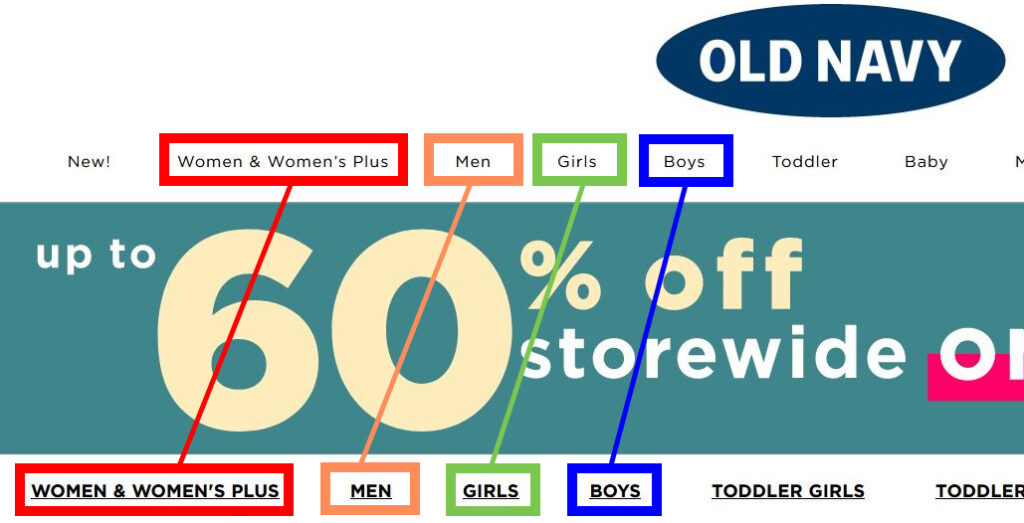
In her article for Nielsen Norman Group, Hoa Loranger addresses whether duplicate links help or hurt a websites’ users
She discusses several reasons why designers use duplicate links:
- Provide safety nets: if a user misses one link, there’s a second link they can find.
- Deal with long pages: websites with long pages might provide duplicate links so that users don’t need to scroll back to the top of the page to find a link
- Create visual balance: if a website lacks content, duplicate links might be used to fill the space.
- Follow the evidence: “analytics show that traffic to desired destination pages increase when links to them are duplicated.”
Loranger explains that instead of using duplicate links to provide safety nets for users, links should be placed in expected locations where they stand out to the user. If necessary, only a few links of a site’s most important links should be duplicated. Additionally, the links should be so far apart that they can’t be seen within the same page view.
Instead of using duplicate links on long pages that require a lot of scrolling, using a sticky menu or “Back to Top” button might be preferable.
Duplicate links should never be used to fill space on a page. Loranger recommends, “[s]urface interesting and relevant information such as facts, announcements, and high-priority items that might be hidden under deep menus or submenus.”
Finally, the fact that analytics show that page traffic increases when duplicate links are used isn’t necessarily a good thing. If page navigation is confusing, users might accidentally visit pages they didn’t want to visit or don’t remember already visiting.